








Is the 2026 Jeep Cherokee or 2026 Honda CR-V better for daily driving around Avon, IN?
York Jeep of Plainfield – Is the 2026 Jeep Cherokee or 2026 Honda CR-V better for daily driving around Avon, IN?
When shoppers ask whether the Jeep® Cherokee Turbo Hybrid or Honda CR-V is better for daily driving around Avon, IN, the answer depends on what “daily driving” includes. If the routine is limited to predictable pavement, school traffic, grocery trips, and occasional highway time, the CR-V certainly brings familiar strengths. It offers a comfortable cabin, available Real Time AWD™, available hybrid performance, Honda Sensing®, wireless Apple CarPlay® compatibility, wireless Android Auto™ compatibility, and a nine-inch color touch-screen across the lineup. For many compact SUV shoppers, that creates a sensible baseline. The bigger question is whether a driver wants a vehicle that does more than meet the baseline. That is where the All-New Jeep® Cherokee Turbo Hybrid separates itself, because it adds standard Jeep Active Drive I 4×4 System across all trims, a no-plug hybrid powertrain, strong towing capability, generous cargo flexibility, and a more rugged SUV personality.
For local drivers, daily driving often means more than a straight commute. A weekday might include I-465 traffic, a stop near Rockville Road, errands along U.S. 36, a quick run to Plainfield, or a weekend route toward parks, trails, lakes, and small-town destinations west of Indianapolis. The Cherokee is especially appealing because it does not ask shoppers to choose between practical efficiency and Jeep Brand capability. Its 1.6L I4 Turbo Hybrid engine uses regenerative braking to support electric assistance without plugging in, so the ownership routine stays simple. Jeep states that the Cherokee delivers 210 maximum horsepower, 230 maximum pound-feet of torque, 37 combined MPG, and more than 500 miles of total driving range. The CR-V Hybrid offers up to 204 horsepower and strong efficiency, but the Cherokee layers in standard four-wheel-drive confidence and an Unsurpassed-in-Class towing capacity of 3,500 pounds.
What Makes the Jeep® Cherokee Turbo Hybrid Strong for Daily Use?
The Cherokee’s biggest advantage is balance. It feels designed for the full range of everyday SUV jobs, not just one narrow category. Standard 4×4 capability gives the vehicle a confident foundation during heavy rain, uneven road surfaces, gravel driveways, rural lanes, and rougher paths near weekend destinations. The Honda CR-V’s Real Time AWD™ is available and standard on select trims, but shoppers must pay close attention to configuration if all-wheel traction is a priority. With the Cherokee, every trim includes the Jeep Active Drive I 4×4 System, so capability is built into the model lineup from the start.
That standard capability is paired with useful dimensions. The Cherokee offers 107 cubic feet of passenger volume, 33.6 cubic feet of rear cargo space, and up to 68.3 cubic feet with the second-row seats folded down. That makes it practical for strollers, sports bags, golf clubs, tools, luggage, folding chairs, pet gear, and home improvement supplies. The CR-V also has a strong cargo reputation, but the Cherokee’s square, confident design and easy-fold rear seat layout make it feel ready for both normal errands and less predictable plans. An available Foot Activated Liftgate adds another layer of convenience when carrying bags or loading equipment.
- Standard traction: Jeep Active Drive I 4×4 System is included across all Cherokee trims.
- Flexible space: The cabin offers roomy seating and up to 68.3 cubic feet of maximum cargo volume.
- Simple hybrid operation: The Turbo Hybrid system does not require plug-in charging.
- Extra utility: A 3,500-pound towing capacity expands what the Cherokee can handle.
How Do the Cabins Compare?
Inside the Jeep® Cherokee Turbo Hybrid, the layout feels modern, sturdy, and practical. The 12.3-inch Uconnect® touchscreen is a standout feature because it is larger than the CR-V’s standard nine-inch color touch-screen. The Cherokee also includes a 10.25-inch Digital Cluster Display, helping drivers view key information clearly from behind the steering wheel. Wireless Apple CarPlay® Support and Android Auto™ Compatibility are available, and an available wireless charging pad helps keep the center console cleaner. Available features such as heated seats, an eight-way power adjustable driver’s seat, Capri Leatherette seating, and an auto-dimming Digital Rearview Mirror give upper trims a more refined feel.
The CR-V counters with practical comfort features of its own, including available leather-trimmed seats, heated front seats on EX and above, dual-zone automatic climate control on EX and above, a one-touch power moonroof on EX and above, and Bose premium audio on Sport Touring Hybrid. Those are appealing features. The Cherokee’s advantage is how the cabin technology, cargo versatility, and Jeep Brand character work together. It feels less like a typical commuter crossover and more like an SUV built for drivers who want a comfortable interior without giving up capability.
Is the Cherokee Better for Towing and Weekend Plans?
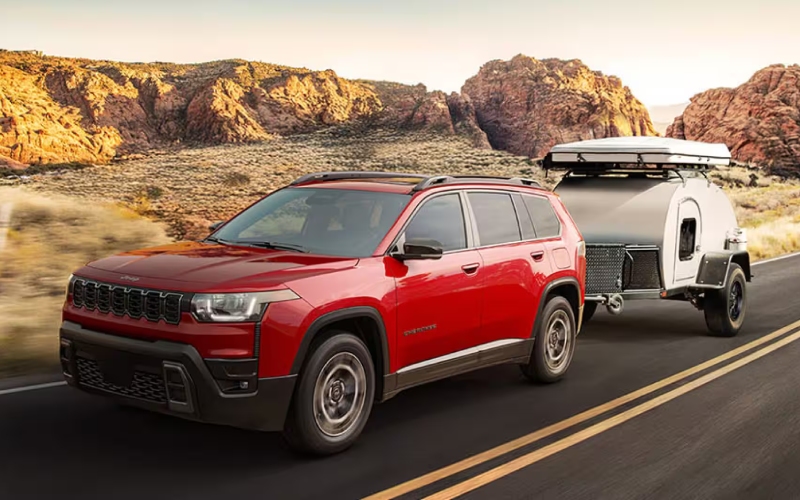
For shoppers who plan to tow, the Cherokee has a clear edge. Jeep states that the Cherokee Turbo Hybrid offers an Unsurpassed-in-Class towing capacity of 3,500 pounds. That number gives drivers more flexibility for a small camper, utility trailer, personal watercraft, or outdoor equipment trailer. The CR-V is not positioned as strongly for towing, especially when compared with the Jeep model’s capability-focused engineering. Even if towing is only occasional, extra capacity can be valuable because needs often change over time.
The Cherokee also brings up to 20 inches of water-fording capability when properly equipped, along with Best-in-Class approach and departure angle claims from Jeep. For the average driver, that does not mean every day becomes an off-road trip. It means the SUV has a deeper reserve of confidence when pavement gives way to gravel, a trailhead road gets uneven, or a weekend plan includes a more adventurous route. That is a meaningful distinction for shoppers comparing a versatile Jeep Brand SUV with a road-focused Honda crossover.
- Choose the Cherokee for capability: Standard 4×4 and strong towing make it the more versatile SUV.
- Choose the Cherokee for technology: The 12.3-inch Uconnect® touchscreen and Digital Cluster Display create a premium interface.
- Choose the Cherokee for simple efficiency: The no-plug Turbo Hybrid system supports long-range driving without charging stops.
How Do Safety Features Factor Into the Decision?
Both SUVs take safety seriously. The Honda CR-V includes Honda Sensing®, which is a respected package of driver-assistive technologies. The Jeep® Cherokee Turbo Hybrid goes further with over 140 standard and available safety and security features. Standard features include Active Driving Assist System, Full-Speed Forward Collision Warning with Active Braking, Blind Spot Monitoring with Rear Cross Path Detection, Active Lane Management System, Adaptive Cruise Control with stop and go, and Drowsy Driver Detection. Available features such as the 360° Surround View Camera can help with parking lots, tight driveways, and busy areas where visibility matters.
Family-focused details also help. The Cherokee provides lower LATCH anchors for the left and right rear seats and three tether anchors across the rear seatback. Jeep also notes Unsurpassed-in-Class Rear Seat Hip Room, which can be helpful when fitting car seats and passengers in the second row. For households comparing daily comfort, safety confidence, and real-world usability, those details make the Cherokee feel especially thoughtfully packaged.
Frequently Asked Questions:
Does the Jeep® Cherokee Turbo Hybrid need to be plugged in?
No. The Cherokee Turbo Hybrid does not need to be plugged in. Its hybrid system gathers electricity through regenerative braking and supports the gas engine automatically during normal driving.
Is the Honda CR-V available with all-wheel drive?
Yes. The Honda CR-V offers available Real Time AWD™, and AWD is standard on select trims such as TrailSport Hybrid and Sport Touring Hybrid. The Jeep advantage is that every Cherokee trim includes the Jeep Active Drive I 4×4 System.
Which SUV is better for towing?
The Jeep® Cherokee Turbo Hybrid is the stronger choice for towing, with a maximum towing capacity of 3,500 pounds. That gives it more flexibility for small trailers and recreational gear than the Honda CR-V.
Which SUV has the larger central touchscreen?
The Jeep® Cherokee Turbo Hybrid offers a 12.3-inch Uconnect® touchscreen. The Honda CR-V features a nine-inch color touch-screen, so the Cherokee provides the larger central display.
For drivers who want a practical daily SUV with a stronger capability story, the Jeep® Cherokee Turbo Hybrid is the more compelling choice. It brings hybrid efficiency without plug-in charging, standard 4×4 confidence, impressive towing capability, advanced available camera technology, and a modern interior centered around a larger touchscreen. York Chrysler Dodge Jeep Ram of Plainfield, serving Indianapolis, Avon, and Brownsburg, offers the Cherokee for shoppers who want an SUV that feels comfortable Monday through Friday and more prepared when the weekend plan changes. The Honda CR-V remains a smart crossover, but the Cherokee delivers a broader ownership experience with more capability built in from the beginning.
0 comment(s) so far on Is the 2026 Jeep Cherokee or 2026 Honda CR-V better for daily driving around Avon, IN?